Creative Photography Ideas in Studio Spaces
Practical, achievable photography concepts for studio environments — from dramatic lighting experiments to clean minimalist compositions.
Setting up a studio space effectively is one of the most practical skills a working creator can develop. Whether you're stepping into a rented space for the first time or refining how you use a studio you've worked in before, the decisions you make in the first thirty minutes of your session will shape everything that follows.
This guide covers the core principles of studio setup — from understanding your light sources to organizing your physical workflow — in a straightforward way that's applicable to photographers, videographers, and audio creators working in a range of studio sizes.
The first thing to do when you arrive in a rental studio is to walk the entire space before touching a single piece of equipment. Most working professionals skip this step and start positioning lights immediately. That's understandable when you're short on time, but a few minutes of deliberate observation will save you significant reconfiguration later.
What are you looking for? Start with the natural light sources. Identify every window in the space and understand how the light is entering — is it direct sunlight, bounced ambient light, or heavily diffused through glazing? Next, look at the walls. White walls reflect light broadly. Dark walls absorb it. This affects how much light spill you'll be managing throughout your session. Then look at the ceiling height, the floor surface, and whether the space has any architectural features — columns, alcoves, irregular surfaces — that might serve as creative assets or practical obstacles.
Understanding the physical reality of the space before you begin sets you up to make deliberate decisions rather than reactive ones.
Light is the foundation of all studio work, whether you're shooting photography, video, or recording audio (where room acoustics are your equivalent concern). The most important distinction to understand is the difference between hard light and soft light.
Hard light comes from a small, concentrated source relative to the subject. It creates defined shadows with sharp edges, emphasises texture, and produces high contrast. It's appropriate for dramatic portraiture, fashion work with an editorial aesthetic, and still life photography where you want to emphasize form.
Soft light comes from a large source relative to the subject — either a naturally large source like a window, or a small source diffused through a modifier like a softbox or reflected off a large bounce surface. Soft light wraps around subjects and creates gradual, subtle shadows. It's the default choice for beauty photography, commercial product work, and interview-style video.
For anyone beginning to build a studio lighting workflow, the three-point lighting setup is the reliable starting point. It consists of a key light, a fill light, and a backlight (sometimes called a hair light or rim light).
The key light is your primary illumination source, positioned roughly 45 degrees to the side of your subject and slightly above eye level. It establishes the overall character of the light in the image. The fill light is positioned on the opposite side at a lower intensity, reducing the shadow density created by the key without eliminating it. The ratio between key and fill determines how much contrast you're working with. The backlight is positioned behind and above the subject, creating separation between the subject and the background. Without it, subjects can visually merge into dark backgrounds.
This framework works as a starting structure, but the best studio photographers and videographers treat it as a beginning rather than a rule. Once you understand why the three-point setup works, you'll know exactly when and how to deviate from it.
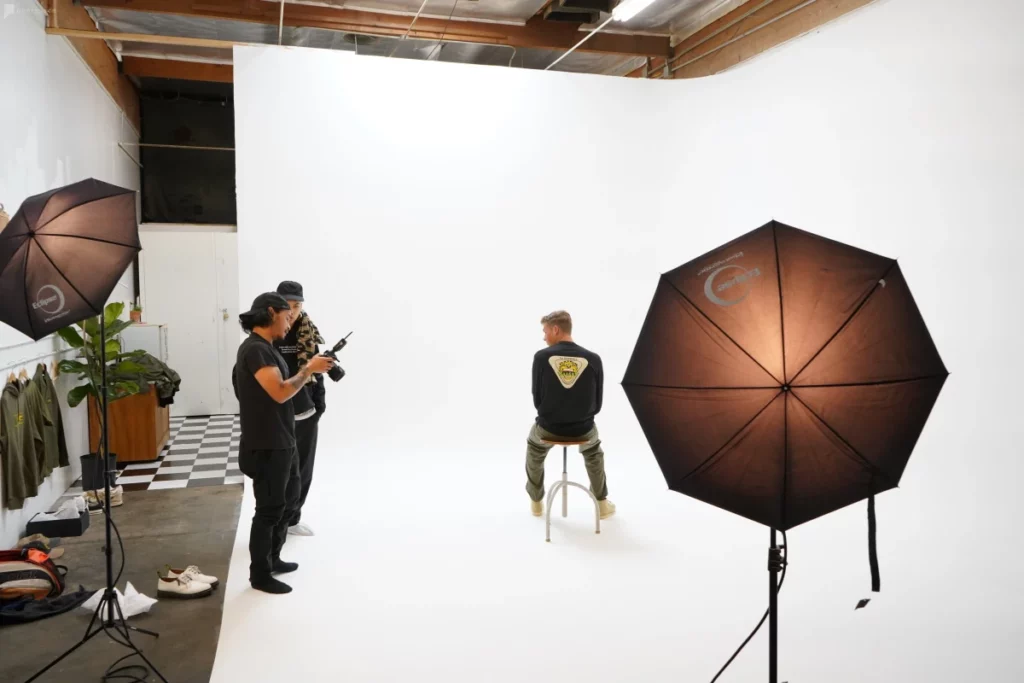
Backdrop choice is one of the most impactful decisions in a studio setup, and one of the most commonly treated as an afterthought. Most studio renters select a backdrop color first and position it wherever it physically fits. A more considered approach is to start with the creative intent of the shoot and work backward.
For most portrait work, seamless paper backdrops remain the most versatile option. White and light gray give maximum flexibility in post-production and maintain a clean, commercial aesthetic. Mid-tones — warm creams, muted greens, dusty blues — provide a more editorial character without requiring significant post-processing. Dark tones and black backdrops create high-contrast, dramatic imagery and are particularly effective in combination with tight, directional lighting.
Backdrop distance from the subject matters significantly. Placing a subject close to the backdrop makes shadows from your key light visible on it — which may be undesirable. Moving your subject away from the backdrop gives you more control over how much light falls on it, allowing you to create a range of tones from deep shadow to bright highlight on a single seamless paper, simply by adjusting your position in the room.
A professional studio session requires thinking about more than just the shooting area. How you organize the rest of the space directly affects how efficiently and calmly your session runs.
Designate a staging area away from the shooting zone where clients or subjects can wait, prepare, or review images. This keeps the main set clear and allows you to make adjustments to your lighting or composition without interruption. Keep all cables and stands organized from the beginning of your session. Trailing cables on a studio floor are a safety hazard and a source of accidental disruption. Most studios have gaffer tape available — use it to run cable along baseboards or at the edges of the space rather than across walkways.
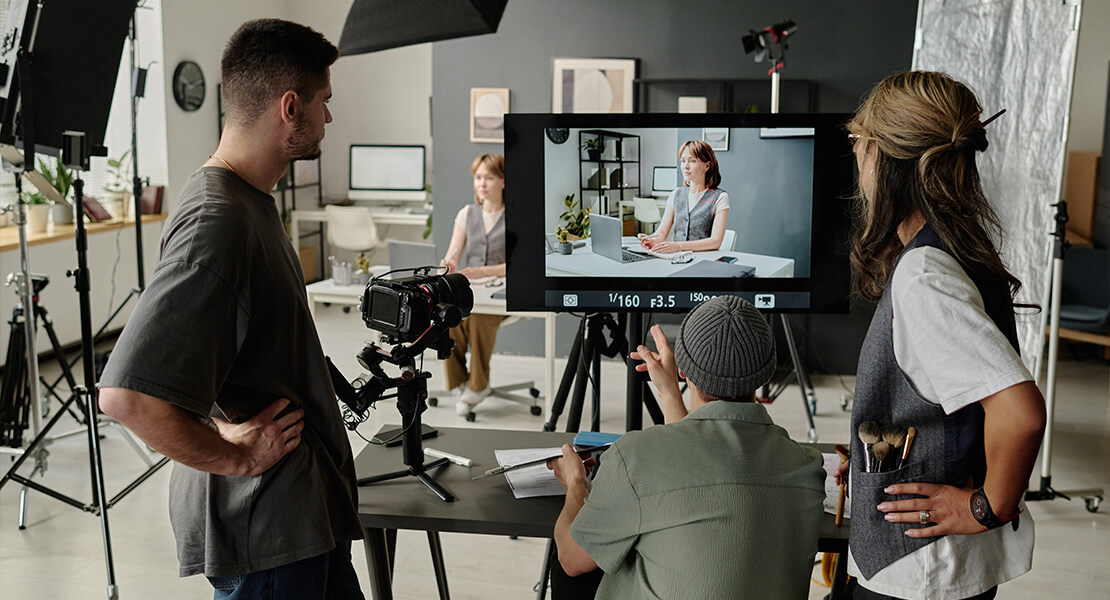
Position your tethered laptop or monitor so that it's visible to you while shooting but not in the eyeline of your subject. For video productions, establish a clear signal protocol with your team so that everyone knows when the camera is rolling and when it isn't.
If you're working in a studio for video, audio setup is often treated as an afterthought despite its significant impact on the finished product. Studio spaces that aren't acoustically treated — which is most general-purpose rental studios — have reflective surfaces that create room ambience and echo.
Test the acoustics of the space by clapping sharply and listening. A short, clean clap is a sign of good treatment. A long, reverberant decay indicates a live room that will require attention. You can improve acoustic conditions practically by adding soft furnishings — rugs, curtains, foam panels — and by positioning microphones closer to subjects rather than using room mics at a distance. A lavalier or clip-on microphone positioned close to the source will almost always outperform a boom microphone positioned at a polite distance in an untreated room.
The end of your studio session is as important as the beginning. Leave the space in the condition you found it — or better. Return equipment to where it was when you arrived, remove your backdrops and prop materials, and make sure all surfaces are clean. This is both a professional standard and a practical consideration: studios that are treated well by their renters are studios that continue to invest in equipment and maintenance for future renters.
Taking a few photographs of the studio before and after your session is good practice, both to document the condition of the space and to capture your lighting setup if you want to recreate it in a future session.
Studio setup is a skill that develops through practice. The principles outlined here — understanding the space before configuring it, thinking about light quality deliberately, using backdrops with creative intent, organizing for workflow efficiency — apply regardless of the studio size, your budget, or the nature of your project.
The most important habit to build is taking a few extra minutes at the beginning of every session to think before you act. The difference between a session that flows smoothly and one that involves constant adjustment is almost always determined in the first half hour.
Book a Luxaviro Studio
Looking for a well-equipped studio to put these tips into practice? Explore our available spaces — from starter photography suites to full production stages.
View Studios