Studio Setup Tips for Creators
From lighting placement to backdrop selection — how to configure a professional studio environment that supports your workflow.
A professional studio is one of the most flexible creative environments available to a photographer. Without the constraints of on-location shooting — unpredictable weather, difficult ambient light, limited control over backgrounds — the studio becomes a blank canvas. That blank canvas can be both liberating and paralyzing. This article offers a range of concrete, achievable photography ideas you can explore the next time you book a studio space.
These concepts are organized by the type of creative direction they pursue, from classic lighting techniques to more experimental approaches. None of them require specialist equipment beyond what most studio rentals include as standard.
Named for the Dutch master painter who favored it, Rembrandt lighting is one of the most recognizable and effective single-light setups in portrait photography. It is defined by a triangular patch of light on the shadowed cheek of the subject — a detail that gives images depth, dimensionality, and a classical quality that works equally well in black and white and color.
To achieve it, position a single light source — a strobe with a medium softbox is ideal — at roughly 45 degrees to the side of your subject and raised above their eye level. The subject's face should be turned slightly away from the light. When the position is correct, the shadow side of the face will catch just enough light to illuminate the cheekbone in a small, defined triangle shape below the eye.
A reflector placed on the shadow side can be used to control how dark the shadow falls — closer for brighter fill, further away or removed entirely for maximum drama. This is an excellent technique to experiment with in a studio because the controlled environment lets you make small incremental adjustments and see the results clearly.
High-key photography uses bright, even lighting to create images dominated by light tones with minimal shadow. It is the language of commercial beauty photography, catalogue work, and a wide range of social media content. In a studio context, it is also one of the more technically demanding setups to execute well — because overexposure and uneven light are easy problems to create and harder to correct in post-production.
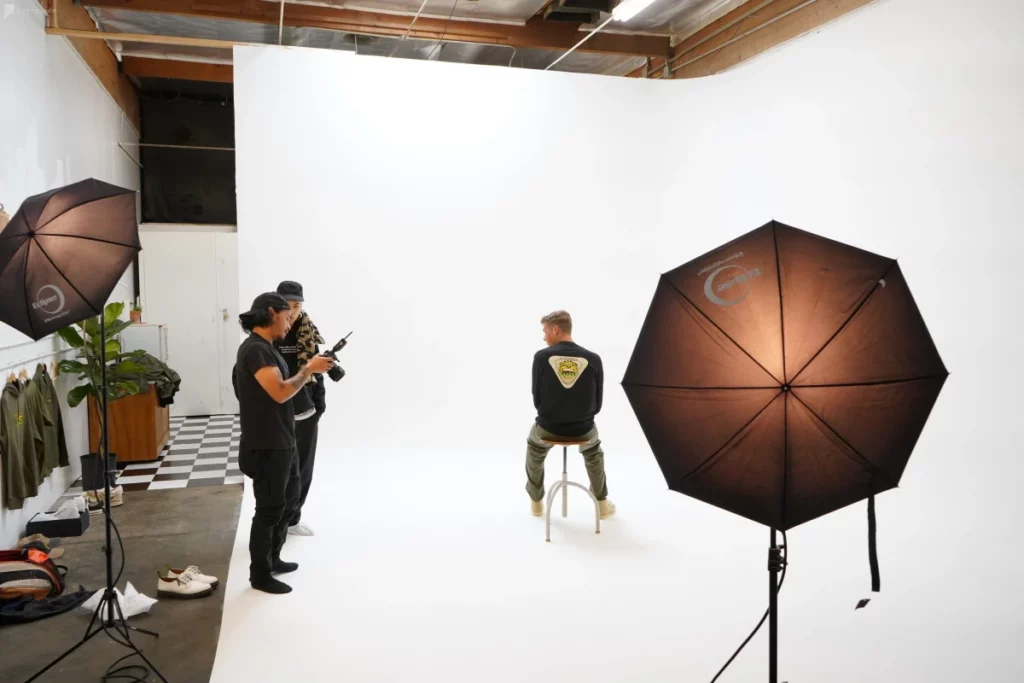
Start with a white seamless backdrop. If you want a pure white background, you need to expose the backdrop itself as well as your subject — which means placing lights specifically on the backdrop, separate from your subject lighting. Position two lights at 45-degree angles behind your subject, aimed at the backdrop, to create even illumination across its surface. Then light your subject from the front with a large, soft source.
The challenge is controlling light spill: the backdrop lights will bounce back toward your subject, flattening the shadows. Managing this through careful positioning and flagging is what separates a technically polished high-key shot from a blown-out snapshot.
Coloured gels are thin sheets of transparent material placed over lights to tint the output. They are inexpensive, widely available, and one of the quickest ways to transform the mood and visual character of a studio image entirely. Most rental studios include at least a basic gel kit, or you can bring your own.
Some approaches worth exploring: using a complementary two-gel setup, where your key and fill lights carry opposing colors (a warm amber key against a cool blue fill, for example), creates a cinematic quality that reads immediately as intentional and considered. Projecting a single saturated gel onto a white or neutral background without using it on the subject creates a vivid color block that gives images a strong editorial quality. Using a gel on a backlight only, aimed at the background, adds depth and separation without affecting the tones of your subject.
Gel work benefits enormously from the controlled conditions of a studio. Even small variations in the position and intensity of coloured lights produce very different results, and a studio environment allows you to explore those variations methodically.
Most studio photography treats shadows as something to minimize or control. An interesting creative direction is to treat shadow as the primary compositional element. This approach has a strong tradition in fashion and editorial photography and produces images that feel graphic, architectural, and unlike the ambient-lit imagery that dominates most social feeds.
Create strong directional shadows by using a single hard light source — a fresnel or bare bulb strobe — without any diffusion. You can use physical objects placed between the light and the subject to cast patterned shadows: venetian blinds, plant forms, geometric cut-outs, or even your own hands. The harder and more distant the light source, the sharper and more defined the shadow patterns will be.
This technique works especially well in black and white, where the removal of color forces the viewer to read the image through its tonal structure alone.
Long exposure photography is most commonly associated with outdoor and night photography, but it translates well to studio conditions — particularly for fashion, dance, and conceptual work. A studio gives you total control over the ambient light level, which means you can create very long exposures even during the day without blowing out your background.
The simplest approach is to use a low ambient light level in the studio, set your shutter speed to somewhere between 1/15s and 1/2s, and ask your subject to move during the exposure. A single freeze at the end of the exposure can be achieved using a flash fired at the end of the shutter cycle (rear-curtain sync), which leaves a sharp "ghost" of the subject at the end of a motion trail.
This technique requires experimentation and patience but produces images that are impossible to fake in post-production and immediately communicates energy and movement.
Moving beyond seamless paper, textured backgrounds — concrete, brick, painted plywood, fabric, paper with deliberate crumpling — add a tactile quality to studio images that can make them feel more grounded and less sterile. Many studios include a variety of backdrop options, and some have architectural features like exposed brick or raw walls that are worth using deliberately rather than treating as an inconvenience.
Layering backgrounds is a more advanced approach: positioning a textured backdrop behind a translucent fabric panel, or projecting texture onto a plain backdrop using a gobo (a pattern cut-out placed in front of a light), creates depth and visual complexity that enriches images without distracting from the subject.
Studios are not only for portrait and figure work. If you're a commercial photographer, a product or macro session in a professional studio can significantly elevate the quality of your output compared to improvised table-top setups. The benefits are controlled, consistent light, the ability to use large reflectors and diffusers at the right distance, and a clean, professional environment in which to handle and position products carefully.
For product work, a shooting table — a translucent acrylic surface lit from below — creates a floating effect for small objects that is difficult to replicate in other environments. Even without a dedicated shooting table, most studios have enough space and equipment to construct effective product lighting setups with standard softboxes and reflectors.
Environmental portraiture typically refers to capturing subjects within their natural context — a chef in a kitchen, a musician on stage. You can simulate the mood and intention of environmental portraiture within a studio by working with props and set dressing. Rather than placing a subject against a neutral backdrop, bring relevant objects, furniture, and contextual items into the studio and build a minimal but coherent environment around them.
This approach requires advance planning — knowing what props to bring, how to arrange them, and what lighting will make them read as intentional rather than cluttered — but the results can be considerably more compelling than a conventional portrait-against-seamless approach.
The value of a studio session isn't only in the images you walk away with. It's also in the skills you develop by working in controlled conditions, testing lighting ideas, and having the freedom to make mistakes without the pressure of an outdoor shoot. Approach your next studio booking as both a production and an experiment — and you'll consistently get more from the time and investment.
Book a Luxaviro Studio
Ready to put these ideas into practice? Browse our available studio spaces across the Abbotsford region and find the space that fits your next project.
Explore Studios